
50 Years Ago A Connecticut Native Crashed His Car — By Accident — Into the Presidential Motorcade

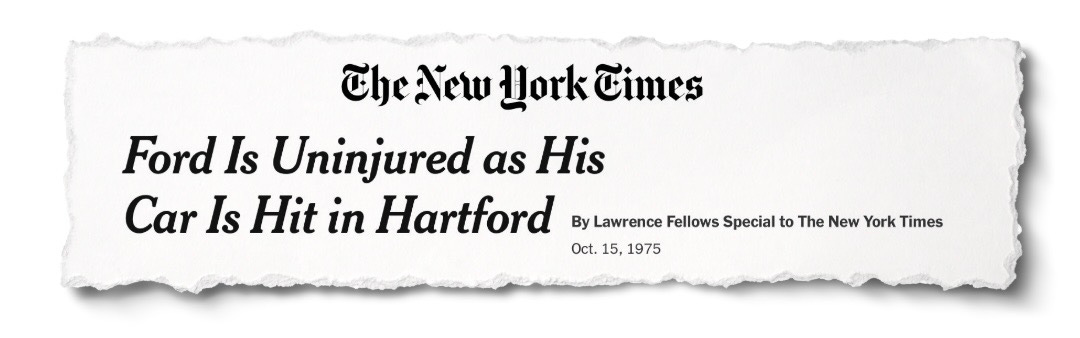
On the evening of October 14, 1975, what began as an ordinary drive through downtown Hartford turned into one of those odd footnotes in presidential history: an automobile driven by a young Connecticut man struck the limousine carrying President Gerald R. Ford as the motorcade left the Hartford Civic Center for Bradley International Airport.
No one was seriously hurt, but the incident — unusual enough that Secret Service spokesmen later called it “the first of its kind” — landed the Connecticut driver on front pages across the country.
The facts, plainly stated
According to the White House daily diary for October 14, 1975, as the President’s motorcade moved from the Civic Center to the airport, the presidential limousine “was involved in an automobile accident with a car driven by James Salamites.” The diary notes the accident occurred en route to Bradley and that the President subsequently boarded Air Force One (the “Spirit of ’76”) for the return flight.
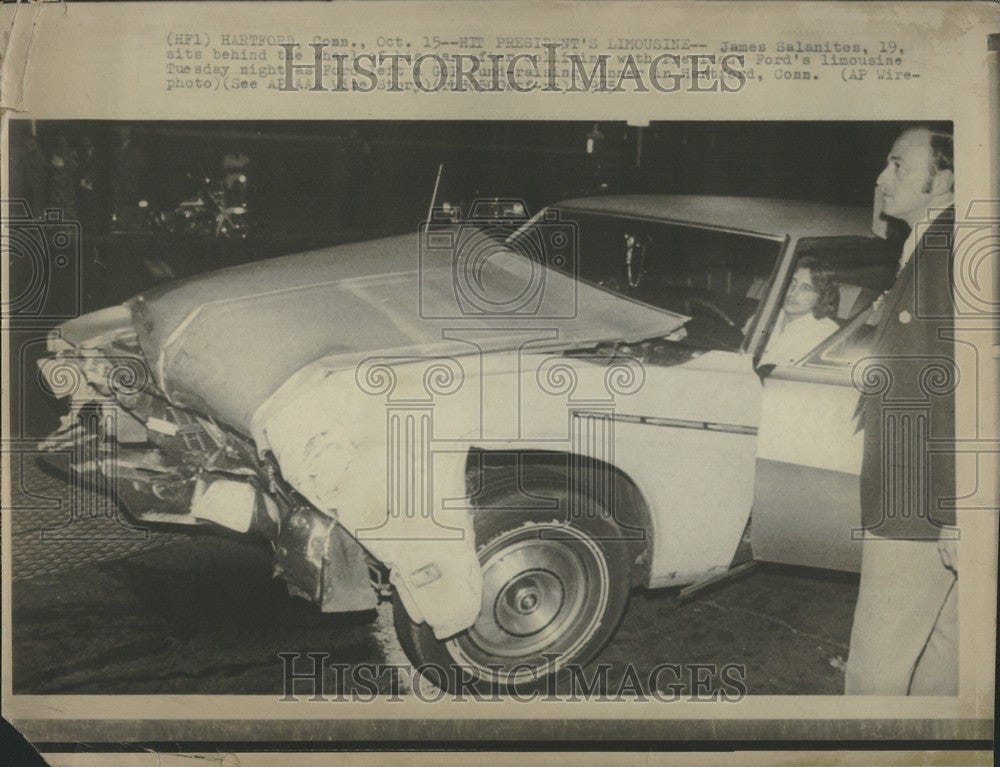
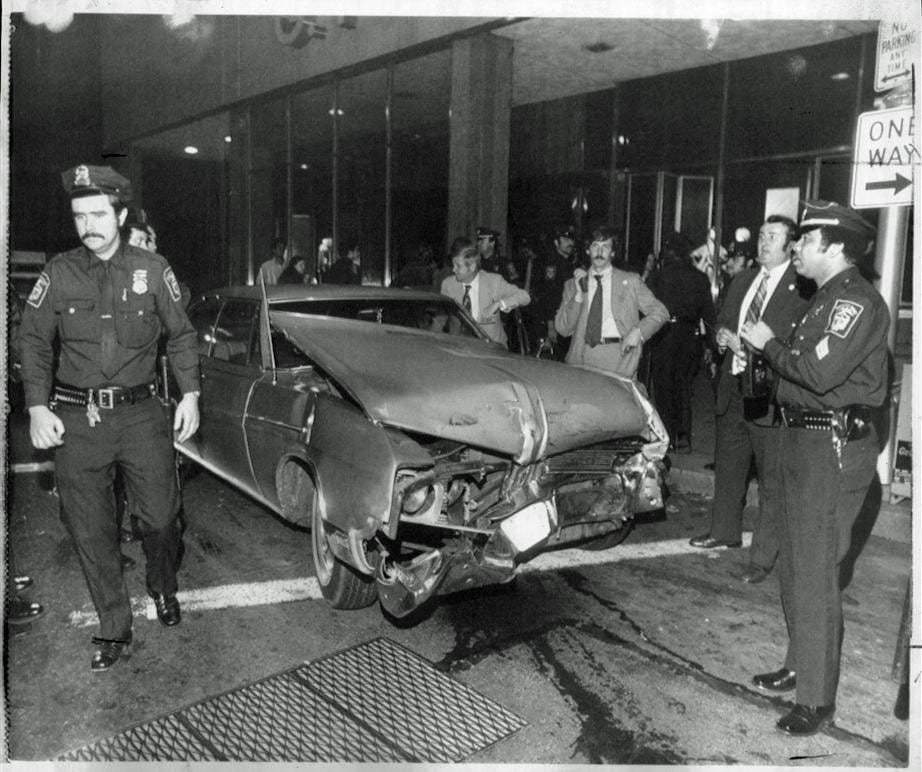
Local and national press contemporaneously described the scene similarly: a Buick (later identified in press photos as a 1972 Buick LeSabre) carrying Salamites and several passengers collided with the President’s heavily armored limousine on a Hartford street. The President was shaken but uninjured; news reports said a fender on the presidential vehicle was bent and the other car was badly damaged.
Who was James Salamites?
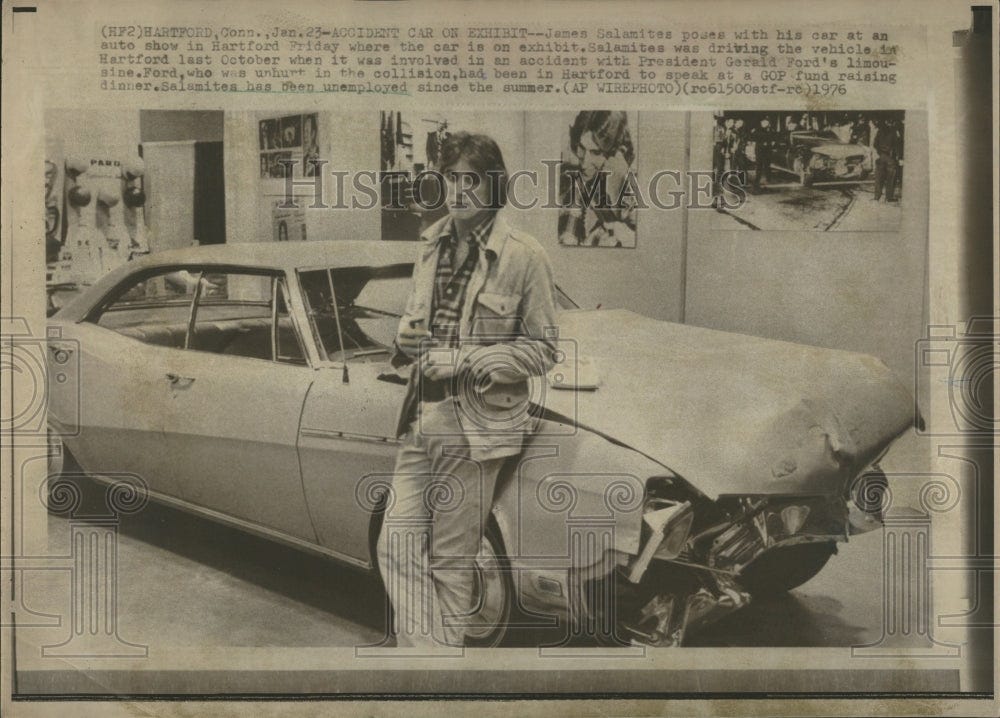
James Salamites — a Meriden, Connecticut, resident at the time — was thrust into an unwanted spotlight. Subsequent profiles and interviews with Salamites reveal a young man bewildered by sudden fame. In a long Washington Post feature published in 1977, Salamites described being “interrogated” at length and later lamented how press coverage made the accident seem like his fault. “I don’t want to be known anymore,” he told the Post. “The accident … did me more harm than good.”
Decades later he told local outlets the episode was simply “a traffic accident,” and that he’d always viewed it that way; still, the crash marked him indelibly in the public record.
Why it mattered then — and why it still interests us
In 1975 the United States was living through a fraught political year — marked earlier by two separate attempts on President Ford’s life in California — so any security-related incident near the President drew special attention. That this incident was an apparent accident, not a hostile act, spared the nation a full-scale crisis. Still, Secret Service briefings and later retrospectives treated the event as noteworthy because of how rare it was for the President’s vehicle to be struck on U.S. soil during a domestic motorcade.
The Ford Presidential Library’s diary entry for the day records the sequence bluntly but dispassionately — the motorcade mishap is one line among a President’s busy evening — a reminder that small, strange events often tuck themselves into larger historical days.
Eyewitness and press snapshots
Contemporary wire copy and later retrospectives captured a range of reactions: dispatches emphasized the good fortune that no one was seriously injured; human-interest pieces focused on the stunned young driver and the surreal attention that followed. The Washington Post recalled repeated television appearances, newspaper headlines, and the humiliation Salamites felt as the episode made him briefly notorious. “When I was arrested it was front page,” he said in that later interview — and when charges or follow-up stories faded, so did the attention, sometimes without correction.
Press photography from the night (and from follow-up coverage and public appearances) shows the battered car, police at the scene, and the presidential vehicle — images that still carry the texture of a 1970s newsroom and a New England night.
The long view
Fifty years on, the Hartford motorcade mishap reads less like a narrowly avoided tragedy than like a moment that reveals how media, security, and ordinary life can collide. For the people involved — Salamites, local police, Secret Service agents, and the Hartford onlookers — it was an unforgettable night. For historians and Connecticut readers, it’s a reminder that even small Connecticut streets have hosted events that briefly pulled the nation’s attention our way.